
THE
ETHERNET

Developed at Xerox PARC
            in 1973.
A standard forMAC(Media Access Control) sublayer.Data transmission rate:10 Mbits/s(Fast Ethernet reaches 100 Mbit/s)High-speeddriveron the computers connected bycoaxorUTPcables.Uses abus(10base2, coax, max. distance 200 mt.) or astar(10baseT, UTP, max. distance 100 mt.) topology.Also usesoptical fibres(10baseF , max. distance 2000 mt.).All nodes wanting to send message contention for the bus.Broadcast the frames to all stations on the network.All stations are continually listening to the bus looking for frames addressed to them.Variable length frames : 64 to 1518 bytes.Transmission time : 50 - 1200 microsec.
Frame Format
            :
Destination address (6 bytes)Source address (6 bytes)Type (2 bytes)Data (46 ... 1500 bytes)Check sequence/checksum (4 bytes).Length of theframeis not provided. Mandatory interval between sending frames. Last 4bytes are assumed to be the frame check sequence (checksum).Type field is sometimes used to store the length of the frame.Not more than 1024 nodes in a single Ethernet, but the address field is 6 bytes.US Institute for IEEE gives a unique id for eachEthernet card. Each node has a unique address.
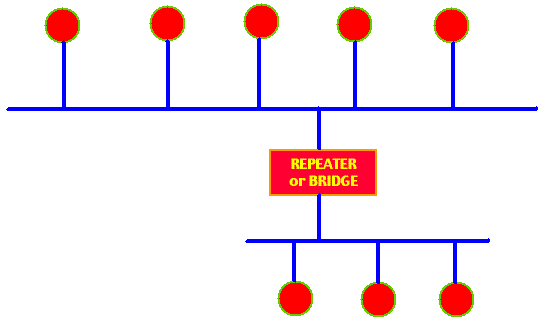
CSMA/CD: Carrier Sense Multiple Access with Collision DetectionPacket Collisions : When multiple stations attempt to send a frame simultaneously. Three mechanisms to address this.Carrier Sensing: Listen for the presence of signal (carrier) in the cable. Wait until there is no signal before transmitting.Collisions may still occur. A sends a signal and B sends it right after that but before it has sensed A's signal.Collision Detection: Send the signal (output port) and listen (input port) and compare the two signals. If they are different then there is a collision. Stop sending the message but send a special signal to intimate all stations that collision has occurred.Retransmitafter waiting for a random time (nT) : T : time taken by a signal to reach all stations, n < MAX: random number. If there is another collision, double MAX and so on.CSMA/CDEfficiency: Fraction of frames transmitted successfully.Possible to get 80 - 95 %. However, noticeable delay after 50%.Interconnecting Ethernets :Repeater: Analog device that simply retransmits the signal it receives.Bridge: Digital so less distortion, may be intelligent, it repeats frames passing only the addresses that are on the corresponding side of the bridge (filtering). Keep a list of addresses. (Note: Each ethernet address is unique).
|
|
WHAT ARE
                  10Base5, 10Base2, 10BaseT & 10BaseF ETHERNET
                  ?
|